
The rating agency, however, pointed out that India's fiscal position remains precarious, with elevated fiscal deficits and net government indebtedness.

After a turnaround in performance by Indian equity markets since July that has seen the S&P BSE Sensex and the Nifty50 wipe out the year-to-date losses, analysts suggest investors start nibbling into stocks that are focused on the domestic economy. While they say intermittent corrections, led by policies of global central banks and other economic data, cannot be ruled out, analysts expect India's relative outperformance among global equity markets to continue as it looks better placed with a healthy economic recovery, and remains one of the fastest growing major economies. In this backdrop, Neeraj Chadawar, head of quantitative equity strategy at Axis Securities, believes that amid global slowdown, aggressive tightening by the central banks, and preference for domestic interests first (by the local government), export-oriented themes are likely to be muted or will deliver conservative returns in the near-term.

The government has decided to spend big on infrastructure across a wide variety of sectors to give a greater impetus to the economy which is recovering from the impact of Covid-19, Finance Minister Nirmala Sitharaman said on Monday.

American brokerage firm Morgan Stanley on Thursday sharply cut its India FY23 real GDP growth estimate to 7.9 per cent, mainly due to the impact of the Russia-Ukraine conflict on oil prices. Analysts at the brokerage also raised their inflation forecast to 6 per cent - the upper end of the tolerance band for the RBI - and flagged stagflation risks because of the ongoing events. "We believe that the ongoing geopolitical tensions exacerbate external risks and impart a stagflationary impulse to the economy," they said. It can be noted that stagflation involves a stagnancy in output or growth, coupled with high inflation.

It's high time the government accounts everything on an accrual basis rather than cash basis
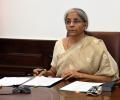
Rationalisation of income tax slabs, infrastructure status for digital services and incentives to hydrogen storage as well as fuel cell development were some of the suggestions made by various stakeholders at the pre-Budget consultation meeting convened by Finance Minister Nirmala Sitharaman. The customary pre-Budget consultation meetings were held with the finance minister virtually between December 15 and December 22, as per the finance ministry statement. More than 120 invitees representing seven stakeholder groups participated in eight meetings, scheduled during this period, it said.

India's GDP growth will slow down to 5.5 per cent in FY24 from the 6.9 per cent expected in the current fiscal 2022-23, a Swiss brokerage said on Wednesday. The slowdown was attributed to slowing global growth and tightening of monetary policies in the report by economists at UBS India. It said India will be among the "lesser affected economies" in the world, but made it clear that the world's fifth largest economy is not immune from global headwinds.

'Indian families' needs and expectations have gone through a revolution across economic demographics.' 'As this latest Modi-Sitharaman Budget demonstrated, politicians have understood this change. They are responding to it,' points out Shekhar Gupta.

The finance ministry will kick-start the exercise to prepare the annual Budget for 2023-24 from October 10, in the backdrop of revival of the Indian economy and fears of recession in developed countries. The budget for the next year will have to address critical issues of high inflation, job creation, boosting demand, and putting the economy on a sustained 8 per cent-plus growth path. On Wednesday, finance minister Nirmala Sitharaman said inflation is no longer "red-lettered" and the priority for the government now is job creation and boosting growth.

Elevated food price-led inflation could become a sore point for markets, which they seem to be ignoring at current levels, observe analysts. Retail inflation in India - as measured by the Consumer Price Index (CPI) - came in at a three-month high of 6.52 per cent in January 2023, compared with 5.72 per cent in December and 5.88 per cent in November 2022. The inflation print for February, according to Madan Sabnavis, chief economist at Bank of Baroda, will be critical for the Reserve Bank of India's monetary policy committee.
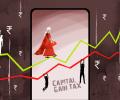
Equity benchmarks Sensex and Nifty ended on a mixed note on Wednesday as the euphoria about the Budget fizzled out, with investors going for profit-taking ahead of the Fed interest rate decision. The 30-share BSE benchmark Sensex climbed 158.18 points or 0.27 per cent to settle at 59,708.08 after it trimmed most of the intra-day gains. During the day, it had zoomed 1,223.54 points or 2 per cent to 60,773.44.

'Recent underperformance notwithstanding, equities should constitute a major part of investors' financial portfolio.'

'That is the one headline the world is reading about India this week, and it is a potentially damaging story...' 'I don't think a panic mentality has set in, but this story is one that investors and market watchers are absolutely seized with.'

'If because of El Nino, the monsoon is affected adversely in the current year, naturally it will affect income projections and consequently Budget numbers.'
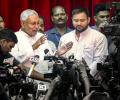
Various indicators make it amply clear that there are grave challenges facing the new government of Chief Minister Nitish Kumar, reports Indivjal Dhasmana.
The first thing the new government has to do is to spell out its plan to deal with the mounting fiscal deficit.

Increase in gold imports pushed the country's trade deficit to a five-month high of $ 15.33 billion in April.

India's macroeconomic situation is certainly better than what it was a year ago, eminent economist Pinaki Chakraborty said on Monday, while expressing hope that the country will be back on the path of economic growth if there is no major third wave of the COVID-19 pandemic. In an interview with PTI, Chakraborty, who is the director of the National Institute of Public Finance and Policy (NIPFP), said that inflation may remain at an elevated level as there was a significant fiscal and monetary expansion in the last 18 months. "The current macroeconomic situation is certainly much better than what it was one year back. We are seeing recovery in most sectors," he said. Chakraborty noted that COVID-19 vaccination has been going on at a very fast rate in India.

PSU divestment, LIC IPO, fiscal deficit: Budget 2021 marks a clear change in the Modi government's stance from fiscal conservatism to growth orientation.

The employment situation remains dire. Whatever can be done to promote greater low-skill employment should be pursued aggressively, advises former chief economic adviser Shankar Acharya.

Although India's share in the world toy trade has marginally improved, it still lags behind China's. Toys are not China's main item of export, but about two-thirds of the toys sold globally are from China. The world exported toys worth $73.2 billion in 2021: China accounted for 66.2 per cent, or $48.5 billion of that, out of which mainland China made up $46.1 billion and Hong Kong $2.4 billion.

The bench said it has to balance the equity and it was not against any policy of the government or the scheme.

After clocking losses for seven straight quarters, Tata Motors on Wednesday posted a consolidated net profit of Rs 3,043 crore in the third quarter (Q3) of 2022-23. This came on the back of a strong order book, better semiconductor chip supply, tempered commodity prices, and a better product mix. "We remain cautiously optimistic about the demand situation, notwithstanding the global uncertainty.
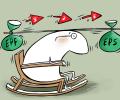
Before opting for this scheme, consider how EPS is calculated.

After a contraction in the current financial year, India's economy is forecast to bounce back with a sharp growth rate of 9.5 per cent next year provided it avoids further deterioration in financial sector health, Fitch Ratings said on Wednesday. The coronavirus pandemic will lead to shrinking of the already slowing economy in 2020-21 that started in April. Fitch Ratings forecast a 5 per cent contraction in the GDP in the ongoing financial year.
It is now becoming increasingly clear that rising imports have played a significant role in sustaining the buoyancy in revenues from GST, notes A K Bhattacharya.

'The signal is crude oil prices will rise, I am cutting my subsidy. Be prepared, prices will rise.'
The external environment has worsened further. While the Finnish economy entered into a recession, Swedish economic growth also dipped. The Finnish gross domestic product (GDP) dropped 0.6 per cent in October-December, 2022. It was the second quarter of negative growth, which is a technical definition of recession.

The Reserve Bank of India on Thursday kept the benchmark interest rate unchanged at 4 per cent and decided to continue with its accommodative stance against the backdrop of an elevated level of inflation.

Union finance secretary T V Somanathan recently said the Centre had saved Rs 10,000 crore in FY22 on interest payments after adopting new accounting mechanisms for central government agencies and centrally sponsored schemes (CSS) for state governments. Speaking at an event, Somanathan said due to these, there was an unspent balance of Rs 1.2 trillion with state agencies from CSS as on March 31, 2022. This means this amount will be reduced from the Centre's borrowing for now and it can be considered a short-term saving for the exchequer.

The ruling Bharatiya Janata Party in poll-bound Karnataka on Friday sought to woo farmers, women and younger generation with a slew of welfare measures in its last budget in the current term, also earmarking Rs 1000 crore towards development and renovation of various temples and maths in the state.

Gross collection of tax on corporate and individual earnings jumped nearly 24 per cent so far in the current fiscal year that started on April 1, the tax department said on Sunday. The gross collection of taxes on corporate earnings rose 16.74 per cent during April 1 to October 8, while personal income tax collection jumped 32.30 per cent, the tax department said in a statement. Direct tax collection came at Rs 8.98 lakh crore between April 1 to October 8, 2022, 23.8 per cent higher than the gross collection in the corresponding period a year ago.

Chief Economic Adviser V Anantha Nageswaran on Thursday said cryptocurrencies are akin to 'a world of Caribbean pirates' in the absence of a centralised regulatory authority and are yet to pass the test of a fiat currency. He said that the government is pursuing a 'high-wire balancing act' to ensure that the gains in growth, inflation, and rupee stability of the last four years are not frittered away. He said the recent development in Terra-Luna cryptocurrency, which witnessed a massive meltdown last month, is a 'very important cautionary tale'.

Voters can be relied on to punish a party which makes reckless promises without actually implementing them, asserts Virendra Kapoor.

Fitch Ratings on Wednesday said India's high fiscal deficit would pose a challenge in lowering the debt to GDP ratio, which is expected to rise above 90 per cent in the next five years. It said India entered the pandemic with little fiscal headroom from a rating perspective. Its general government debt/GDP ratio stood at 72 per cent in 2019, against a median of 42 per cent for 'BBB' rated peers.

The Congress needs to reorganise itself at the grassroots, infuse younger blood, and have more boots on the ground. Just offering freebies is not the answer anymore. Leadership matters, asserts Ramesh Menon.

Senior tax officials were told to focus on cash collection from the arrears so that the target for FY23 was achieved and the overall revenue position improved.

Finance Minister Nirmala Sitharaman on Monday tabled the Economic Survey 2021-22 along with Statistical Appendix in the Lok Sabha on the first day of the Budget session of Parliament. Later, the Lok Sabha was adjourned till tomorrow. The Economic Survey will now be tabled in the Upper House. The Budget Session of the parliament commenced on January 31 with President Ram Nath Kovind's address. The first part of the Budget session of Parliament will be held from January 31 to February 11 and the second part of the Budget session will take place from March 14 to April 8.

The government has decided to postpone the release of the new Foreign Trade Policy (FTP) and extend the existing one by six months on account of global uncertainties and currency fluctuations. The government was scheduled to announce the new FTP by the end of September. The current policy was to end on September 30.

IThe fiscal deficit target for 2020-2021 was originally set at 3.5 per cent of GDP. But the government's revenues have collapsed and its expenditure burden will only increase over the Budget estimates.' With the government having already planned for an additional borrowing of over Rs 4 trillion, the fiscal deficit for the current year would be much higher than the Budget estimate, notes A K Bhattacharya.
